Thursday, 10 February 2011

Estates


I didn’t buy this because of the cover -- I ordered it blind from Amazon -- but it’s lovely, isn’t it. Is that Gill Sans?

It’s good. The first chapter’s about her own and her family’s experience of public housing (for North American bloggees, the ‘estates’ of the title are ‘council estates’ which means public housing developments/projects built and run by local authorities, the councils). The second is the best history I've seen of public housing in Britain -- a sad story. Wonderful development to start with -- Boundary Row in Bethnal Green which I've often walked through and admired -- by the LCC at the end of the 19th century. ‘Homes fit for heroes’ after the first war, built to the highest standards (‘Tudor Walters’), as were those provided by Bevan (Minister of Health and Housing) after the second -- but in both cases the gain in space and fresh air (the developments were on the edges of cities) were at the price of remoteness from family and work. In both cases, too, the standards of building were relaxed after a few years out of a need for economy, more rapid provision and higher density, so that whereas at first the council houses looked and were as good as those the spec builders were selling to private buyers, before long they were standing out a mile and attracting the social stigma that they’ve never since thrown off.

Then came ‘systems building’ (prefabricated units) and tower blocks and the familiar scene around us today in the inner as well as the outer city.

Consciousness

About ten years ago I had something called an iPaq, made by Compaq. It was a PDA but the beauty of it was you could buy a folding keyboard for it, called a Target Stowaway. It was in three parts and when folded it was the same size as the iPaq, comfortable pocket size, and I could easily take it into libraries, on trains etc. I had to abandon it when I switched from PCs to Macs and couldn’t get it to communicate.

I wish I could find something like that now. A virtual keyboard on a screen (iPhone, iPad) is no good for writing more that a few words. So when the muse or some other harridan strikes when I'm out, I’m reduced to writing in a notebook and then typing it on the computer when I get home.

If there’s time, that is, which often there isn’t, which is why you didn’t get what I scribbled on 27 January, which was:

‘The claim that the self is an illusion is philosophically incoherent -- i.e. bollocks.’

I noted down a trivial and rather annoying train of thought I’d just had -- some puzzle about the ticket barriers worked at Waterloo -- and wrote ‘It’s impossible to see these thoughts as just material movements. There was intentionality, desire, a form of wanting to know. If there was a chattering monkey -- which there was in that these weren’t thoughts I was wanting to have and they were distracting: I’d have preferred my mind to be still -- the monkey was me.

‘The incoherence in the statement that the self is an illusion is revealed in the observation that who can register that statement in consciousness -- evaluate it as true or false, accept it or reject it -- except a self, a consciousness?’

Now I see Mary Midgley reviewing a book on consciousness by Nicholas Humphrey (Guardian Review. Saturday 5 February) and observing that ‘Humphrey... still rules that this everyday consciousness is indeed an illusion. He seems not to notice that illusions are impossible unless somebody conscious is there to be deluded.’

Exactly. Good to find one’s idea anticipated those of a real thinker. Which is what has motivated me at last to get down to it and type out my scribble.

She needs a word ‘illuded’, doesn’t she.

Wednesday, 2 February 2011

The meaning of meaning

I’ve always had trouble with English teachers, primary school teachers, advisers, lecturers and the like who talked about children ‘making meaning’. I still hear it now occasionally but did a lot in the 70s and 80s and indeed there were books and articles with the expression in the title. Those who used it may have known what they meant but I never thought I did, which makes me think, still, that it was a mystificatory idea that served to conceal confusion.

Previously, people had only used the term ‘meaning’ in phrases like ‘the meaning of so-and-so’. As for ‘meanings’ plural, you got it in ‘word meanings’ and expressions like that -- ‘words and their meanings’ -- but never, I think, in isolation. Meanings were pretty well what you could find in the dictionary.

So what were these meanings that children were supposed to making? Well, I suppose they were the meanings of their written and spoken utterances or improvised dramatic actions, since it was always in relation to language or drama that the expression was used. There seemed to be a whole implicit theory in this way of speaking, that ‘behind’ the language was a non-language something that either preceded the utterance (less preferred version) or was precipitated by the utterance, in the course of speaking.

Well, then. First: if that was the implicit theory, it seems to have huge implications and needed spelling out -- and I don’t think it ever was. If it wasn’t, then ‘meanings’ were just a placeholder, like an algebraic x, for whatever the language or gesture meant, in the usual sense. It’s the implication that there’s some separate entity that children are making, to which language etc may be contributory in production but finally inessential, to which I object. Or rather, I object to the undeclared smuggling in, as if it’s unproblematic, of such a vast notion about the constitution of ideas.

I once took ages working in detail, in an effort to understand it, through the final chapter of Vygotsky’s Thought and Language, the classic source of insights into this area, and concluded that I didn’t understand it and that it was either seriously defective in failing to explain some essentials or was incoherent. Vygotsky can’t be blamed: he was dying and in a rush. But I've never found what to turn to by way of a satisfactory modern (post-1935!) treatment of the problem and I remain seriously confused.

As others surely must be, but I don’t hear much worry being expressed. The issue is almost never addressed in any contemporary writings on the teaching of English, for any theory of which one would have thought some account of language and thought would be essential. Essential, too, to an evaluation of how important the much-celebrated ‘multimodality’ is: is the role of visual media, for instance, in ‘making meanings’ as significant as that of language? on that depends (in part) the weight that should be given to it in education -- and how much time should go to media studies.

Sunday, 30 January 2011

Chekhov world-weariness

This is rather how I felt in some of the places I've lived:

ANDREY: Oh where is it now, where has my past gone, the time when I was young, merry, clever, when I had fine thoughts, fine dreams, when my present and my future were lit up by hope? Why is it that no sooner have we begun to live, we become boring, grey, uninteresting, lazy, indifferent, useless, unhappy . . . Our town has existed now for two hundred years, it has a hundred thousand inhabitants - and not one of them who isn't exactly like the others, not one hero, not one scholar, not one artist, not one who stands out in the slightest bit, who might inspire envy or a passionate desire to emulate him. They just eat, drink, sleep, then they die . . . others are born and they too eat, drink, sleep, and in order not to be dulled by boredom, they diversify their life with vile gossip, vodka, cards, law suits, and the wives deceive their husbands and the husbands lie, pretend they see nothing and hear nothing, and an irremediably coarse influence weighs down on the children, and the spark of God's spirit dies in them and they become the same kind of pitiful corpses, one like another, as their mothers and fathers . . .

Chekhov Three Sisters, Act 4

Monday, 24 January 2011

The feel of ordinary life

Philip Pullman said something good about about the Chekhov story he’d read (Guardian short stories podcasts, ‘The Beauties’), about the plot not being the point but rather the often inconsequential texture of ordinary life. It’s true of Chekhov’s plays, too -- that’s one way he was a Modernist innovator. The story, says Pullman, is like the man said about Waiting for Godot, ‘In this play nothing happens -- twice.’

I recalled this when looking at a kids’ comic strip by Jim Medway, in which nothing happens five times, on successive days.

Now I've hit on another good quote from much earlier, as it happens in the introduction to Chekhov’s plays that I'm reading as preparation for seeing The Three Sisters tomorrow (by the Russian company again, so we’ll see what they do with something good). The author writes:

Chekhov surely must have read Gogol's famous 1836 denunciation of theatre in Russia during the early nineteenth century and beyond. After deploring the stage's corruption by 'the monster . . . melodrama', Gogol went on to ask 'where is our life, ourselves with our own idiosyncrasies and traits?'…. 'The melodrama is lying most impudently,' Gogol went on. 'Only a great, rare, deep genius can catch what surrounds us daily, what always accompanies us, what is ordinary — while mediocrity grabs with both hands all that is out of rule, what happens only seldom and catches the eye by its ugliness and disharmony . . . The strange has become the subject-matter of our drama. The whole point is to tell a new, strange, unheard-of incident: murder, fire, wild passions . . . poisons. Effects, eternal effects!'

Voltaire DID care about liberty

I said (here) that De Tocqueville said that the philosophes weren’t interested in England, and (somewhere) that I've started reading Voltaire’s Letters on England. Well, the latter seem to refute Voltaire: see the following (Penguin, 44-5):

Here is a more essential difference between Rome and England which gives all the advantage to the latter: the outcome of civil wars in Rome was slavery, and that of the troubles in England liberty. The English nation is the only one on earth which has succeeded in controlling the power of kings by resisting them, which by effort after effort has at last established this wise system of government in which the prince, all-powerful for doing good, has his hands tied for doing evil, in which the aristocrats are great without arrogance and vassals, and in which the people share in the government without confusion….

The government of England is not made for such great glory [as Roman conquests] nor for such a terrible end [as the suppression of the plebs]; its object is not the brilliant folly of making conquests, but to prevent its neighbours from making any. These people are not only jealous of their own liberty but also of that of others. The English were fiercely hostile to Louis XIV simply because they thought he was ambitious. They made war against him with a light heart, certainly without self- interest. No doubt liberty has only been established in England at a heavy cost, and the idol of despotic power has been drowned in seas of blood, but the English do not feel they have paid too high a price for good laws. The other nations have had no fewer troubles and have shed no less blood, but the blood they have poured out in the cause of their liberty has only cemented their servitude.

The Cézanne book

I said I’d bought the catalogue -- a lavish and lovely production and value for money, I’d say -- and I turned to the chapter by Richard Shiff, ‘He Painted’, in the hope that it would tell me more than its title. It starts rather uninterestingly, for me, about Cézanne’s early reputation, but soon starts to say some helpful stuff, first by quotes and then in his own explanations.

So, Duret (1906) calls his technique, ‘strokes next to each other, then on top of each other’ - as if ‘he lays his painting with bricks’. Then Shiff asserts that ‘the historical trajectory’ of this technique (Courbet, perhaps) ‘need not engage the forces driving social history at any given time.’ (So somebody suggests or could suggest it might? interesting....) ‘The possibility of aligning aesthetic and social stars hardly motivated Cézanne’ (so it might, or did, others? I’d like to know more -- should read more art books....)

Then there’s stuff on whether Cézanne dehumanises his figures -- again, not something that worries me. This concern comes from Meyer Schapiro (1952), who then is quoted with this lovely formulation about The Card Players: ‘The inherent rigidity of the theme is overcome also by the remarkable life of the surface. There is a beautiful flicker and play of small contrasts.’ Shiff comments that ‘fllicker’ is right, and it is, and says that it has the effect of making the surface appear to ‘warp’, which it does.

Then, to my delight, he confirms that, as I said in the first post, Cézanne’s marks aren’t all representational: ‘Yet Cézanne’s characteristic warp does not necessarily adhere to the representational anatomy or the logical arrangement of a figure in the space of a room.’ Rather what happens is an ‘insistent sequencing of parallel marks and alternating colours’, regardless of ‘the depicted subject’.

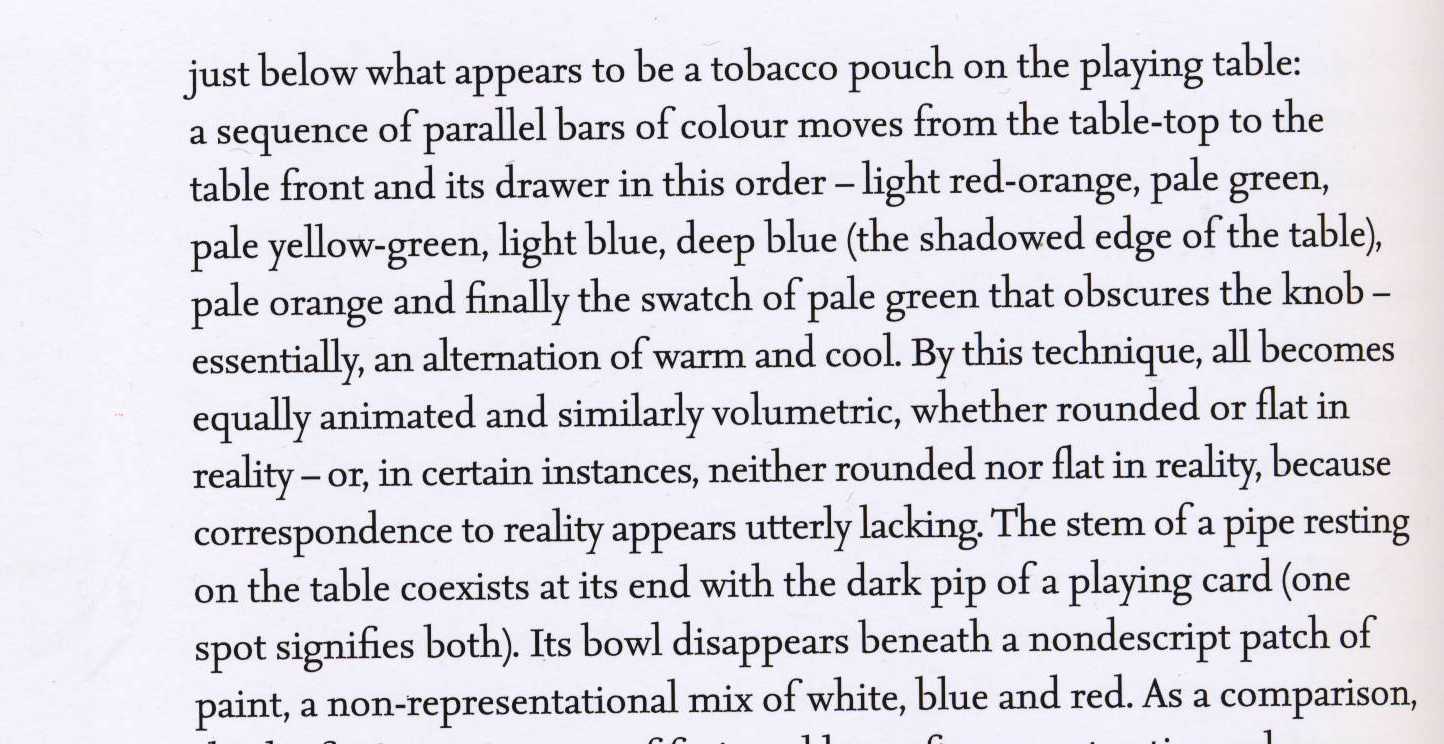
What follows is then terrific and just the sort of art criticism I need. Best if I try to reproduce a couple of pages. Start at the second para on p.79. Click on images to enlarge.